TAC launches the ‘People’s Health Manifesto’ 2024 ahead of elections
10 May 2024
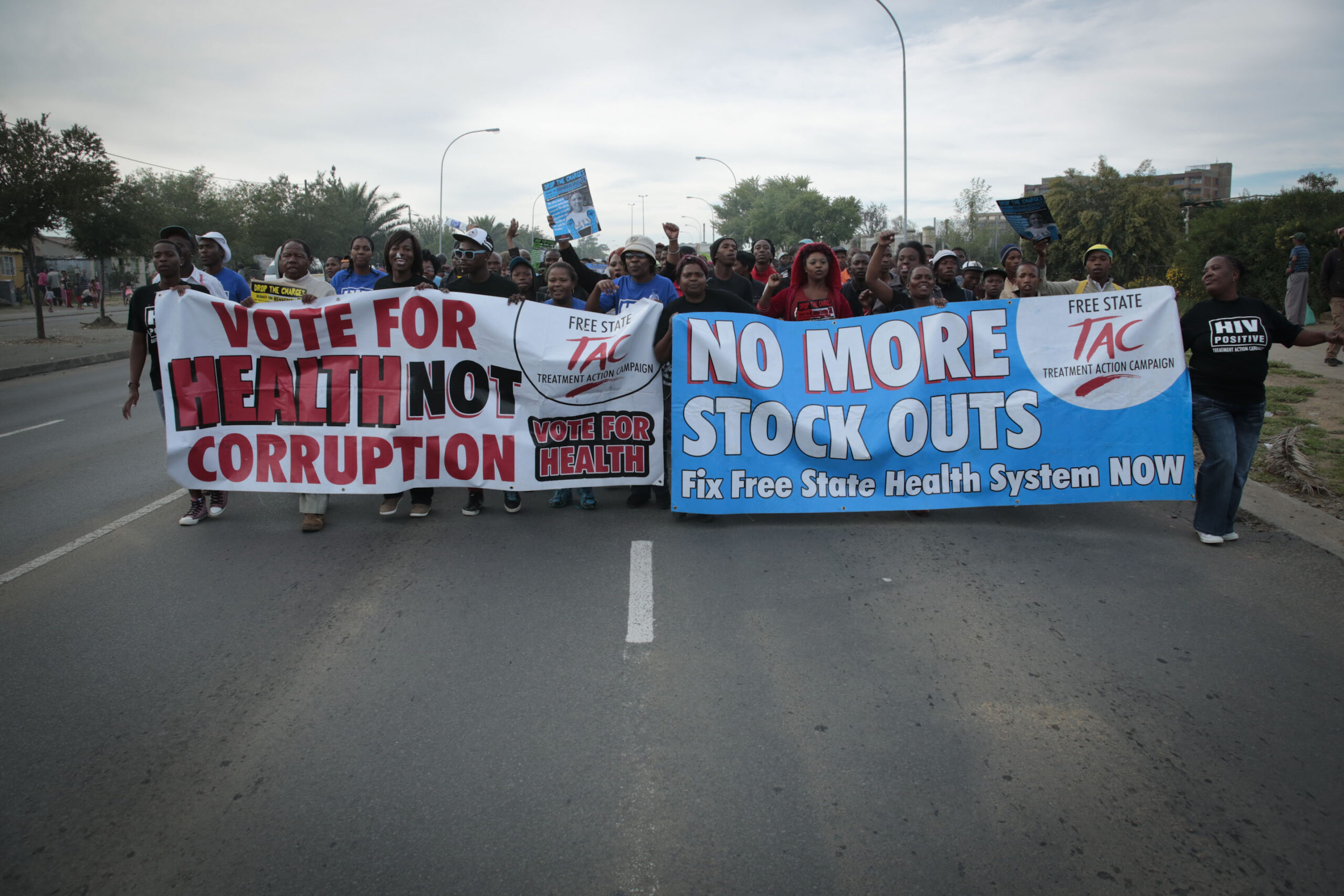
Johannesburg, 10 May 2024 – The Treatment Action Campaign (TAC) today launched its People’s Health Manifesto. The manifesto has 25 key demands that highlight key interventions needed to improve South Africa’s health outcomes.
TAC consulted widely with our members and partner organisations and used the latest community-led monitoring data to develop a ‘People’s Health and Rights Manifesto’ where we raise critical issues related to healthcare, HIV, TB and Key Populations services and rights and convince our members and public why they should vote and what they should vote for.
Below are the 25 key demands:
Sufficient numbers of healthcare workers — including doctors, nurses, pharmacists, pharmacy assistants, community healthcare workers, lay counsellors, peer-educators, and even security guards and cleaners.
Waiting times brought down under two hours across all sites. Appointment days and times used to spread out appointments throughout the day and ease congestion at clinics. Facility pick-up points that are a one-stop very quick ART collection-More external pick-up points set up for people established on ART to be referred to, closer to their homes.
Filing systems to be maintained in an organised manner to reduce lost files. Infrastructural renovations to ensure that all clinics have sufficient space to maintain a functional filing room. The establishment of an effective, confidential, electronic medical records system
All facilities to be maintained to the highest standards of cleanliness including through implementing regular cleaning rotas, and soap and toilet paper provided in all clinic toilets.
All public health facilities to have a functional generator with sufficient fuel, rechargeable bulbs, and other useful loadshedding devices so that health services and administrative work can continue during power outages
An NHI that is an inclusive system that protects the most vulnerable and marginalised, with adequate checks and balances.
Reliable, available, quick, and quality emergency medical services and planned patient transport systems in South Africa.
12 monthly prescriptions and the rapid rollout of 3- and then 6-month supply of ARVs to reduce unnecessary burdens on people living with HIV and the health system. Quality clinical management when people are required to come to health facilities to see a clinician (not just a rescript and refill).
Establishment of the functional clinic committees that are not aligned to party politics or who are deployees of the ward councillors.
More pick-up points to be established near/closer to where people stay, especially linked to peri-urban and rural clinics. All stable people living with HIV being offered and voluntarily enrolled into the pick-up point or adherence club of their choice. Facility pick-up points are a quick, one-stop very quick ART collection
Healthcare workers to provide friendly and welcoming services and acknowledge that it is normal to be late for or miss appointments, and to support people living with HIV to re-engage in care. People never to be sent to the back of the queue when they return after a late appointment
A full package of psychosocial support at all clinics including: provision of individualised quality assured counselling, peer-led patient navigators, mapped networks of referral services, optional support groups, and food parcels.
All healthcare workers provide timely, accurate, and easily understandable information on treatment literacy and adherence, and the importance of an undetectable viral load through consultations, counselling, health talks, and outreach.
Services at all public health facilities must be safe, friendly, welcoming, and confidential for people who use drugs, sex workers, and LGBTQIA+ communities.
HIV prevention tools including lubricants, external and internal condoms, PrEP, and PEP are easily available at all public health facilities,
People who use drugs are able to access harm reduction tools like new needles, methadone, naloxone, drug dependence support, closer to home. Policies should be amended to ensure that naloxone is not only nurse initiated, but can be initiated by community members themselves. Methadone programmes should be made available in public clinics, not only in a small selection of drop-in centres.
All facilities provide gender affirming services including: using trans people’s correct name and pronouns, providing a gender neutral toilet, and maintaining respect, privacy, and confidentiality. Policies should be amended to ensure that trans people are able to access hormone therapy from doctors in clinics locally.
Improved diagnostics and treatment for people with AIDS and cryptococcal meningitis. Improved identification and management of people with advanced HIV disease ( AHD). A CD4 test for every person newly diagnosed with HIV or returning to care sick or after interrupting ART f
Implementation of Targeted Universal TB testing (TUTT) that gives everyone at high risk of TB a TB test in all public health facilities. 3HP — a newer and better TB preventive therapy
All public health facilities follow a checklist of basic measures to ensure adequate TB infection control measures are in place. An audit of all public health facilities to assess TB infection control, based upon WHO guidelines
All public health facilities have the medicines, vaccines, contraceptives, diagnostic tests, and dry stock they need to provide quality health services. No-one is turned away empty handed due to a stockout or shortages of medicines. Improved supply chain management across provinces, which adequately report stock availability.
Development and passing of legislation to reform our patent laws, to ensure medicines are made more affordable
The NDoH to establish an anti-corruption unit to work with the Special Investigating Unit (SIU) to fight against and root out all corruption within the healthcare system
Women and LGBTQIA+ community members are treated with equality, dignity, and respect, as outlined in the Constitution
Our clinics and hospitals treat people capable of pregnancy with respect and dignity. Sexual and reproductive health service provision is safe, friendly, and confidential. No obstetric violence takes place, including abuse (physical, sexual, or verbal), bullying, coercive practices, humiliation, and/or assault towards labouring and birthing people.
For media engagement, please contact:
Xabisa Qwabe | Communication and Media Coordinator | +27 76 850 6736 | xabisa.qwabe@tac.org.za