TAC General Secretary’s intervention at TB Proof National AGM
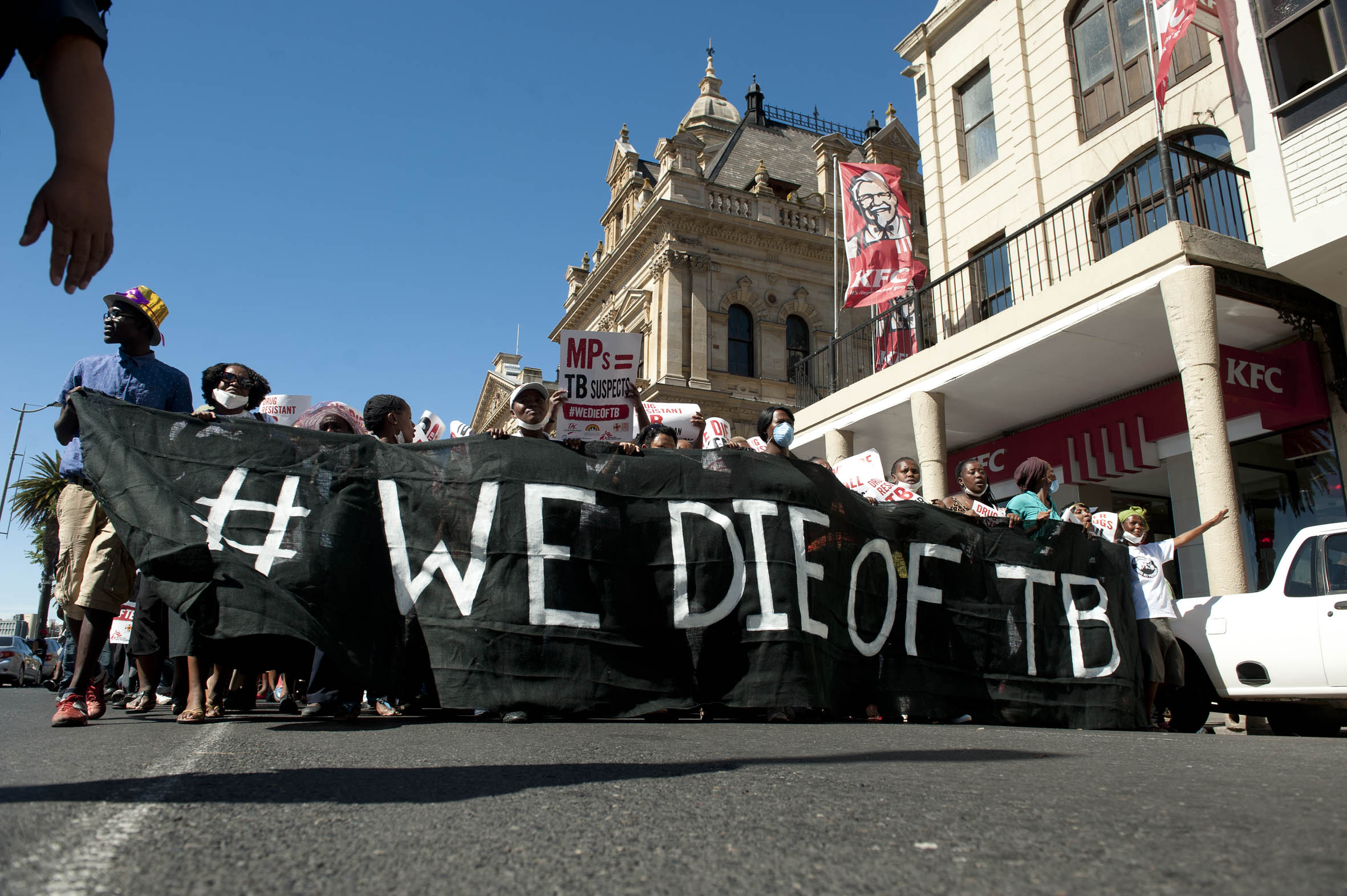
TAC march to Parliament, World TB Day, 24 March 2015.
Cape Town, 13 January 2024 – Today Anele Yawa, the General Secretary of the Treatment Action Campaign (TAC), gave the following intervention at TB Proof’s national AGM.
Comrades and friends thank you for inviting us to join you on this august annual general meeting of TB Proof. I was requested to come and join you over the past two days and in that process, I was requested to talk about advocacy issues around TB response in the country.
According to WHO’s 2023 Global TB report, in South Africa, around 280 000 people developed TB, of this number 152 000 are PLHIV and 11 000 are with MDR TB. In total we have 54 000 TB deaths recorded during this period, of this number, 31 000 are PLHIV. What does this mean, when comparing to the previous report? It means:
(1) TB incidence have gone down by 20 000 from the last report released by WHO, from 300 000 to 280 000,
(2) A decline on TB deaths from 56 000 to 54 000 compared to the previous report released by WHO.
This is a drop in an ocean as compared to the ambitious targets we set for ourselves as the country, and something needs to be done to turn this situation around.
I wish to spend the few minutes and talk about three things, which are:
(a) Why must we intensify our campaign to call upon our government to declare TB a public health emergency.
(b) To reflect on TB recovery plan that was promised to the people of our country.
(c) and what needs to be done to improve the quality of TB services in our country?
Just to jog our memories, in March 2021, we Marched during the World TB Day that was held in Mbombela-Mpumalanga calling for our government to declare TB a public health emergency. We had and still call upon our government to do to TB what they did to COVID19, among other things we are calling for, is a political will and commitment from our government, we are calling for more resources to be injected in our country’s response to TB to improve the quality of TB services, we are calling for frontline healthcare workers working on TB, we are calling for people to be screened for TB upon arrival or entering a health establishment.
After our March, we held number of meetings with the then Deputy President DD Mabuza as the SANAC Chairperson and Dr Zweli Mkhize as the then Minister of Health. Some of us in this room were part of these meetings. Many promises were made to us and eventually a TB recovery plan was introduced and Dr Norbert Ndjeka was appointed to lead and oversee the implementation of this emergency plan, unfortunately we never saw injection of more resources, instead we saw numerous budget cuts on HIV and TB service by the National Treasury. This is a serious indictment to the thousands of people who are contracting and dying of TB every year in our country. This is crime against humanity, and it must be characterised as genocide to people living with TB.
When we called for our government to declare TB a public health emergency, it is because we saw the number of people who are contracting and dying of TB in our country and the majority of them were and are still among PLHIV. We are still witnessing many people with TB disengaging from care and this is resulting on high lost to follow up on TB treatment and care. We witnessed more resources from TB and HIV conditional grant being shifted to COVID19 response while TB services are still in shambles resulting to poor quality of service delivery and many people dying.
When the TB recovery plan was introduced, we were all excited because we thought that this was a great move towards the right direction and that things will start happening in our country’s response to TB through the recovery plan. We dropped the ball not because of our own will, but we were excluded on other engagements that were determining how the recovery plan was going to be executed. We were not invited in meetings that took critical and important decisions on how this plan was going to be implemented.
We were just informed that the TB recovery plan was going to be implemented in twelve (12) high TB and HIV burden districts in the country. The TB recovery plan was meant to be implemented from April 2022 to March 2023. We are now in January 2024, what has our country achieved through the TB recovery plan in response to TB services? I think, this is where we need to start.
The objectives of the TB recovery plan as we were told, was to: Mitigate the losses incurred during the COVID19 pandemic lockdown and scale up new innovative approaches to attain the NSP, End TB strategy, UNHLM and SDG targets.
The sub objectives were to:
1. Find people with undiagnosed TB in our communities,
2. Trace and bring back to care people who were lost to follow up,
3. Strengthen systems for linkage and retention to care,
4. Strengthen monitoring, evaluation and surveillance systems,
5. Strengthen TB infection prevention and control,
6. Intensify communication and social mobilisation, and
7. Engage all sectors in the TB response.
The TB recovery plan was supposed to be project managed and implemented over a period of one year. We were told that, human and financial resources were critical to the success of the plan. We were further told that, a clear monitoring and evaluation framework was going to be developed to ensure accountability at all levels by all sectors.
For impact, we were told that a targeted approach will be implemented by prioritising high burden TB and HIV districts for for intensive support and this will entail identification of TB hotspots based on burden of HIV and TB disease in these districts and mapping the facilities and communities to target.
The implementation of of the emergency intervention was divided into two phases relating to the time period for the implementation of the plan, namely, phase one: over a period from January to March 2022 and phase two: from April 2022 to March 2023.
As TAC we have been monitoring the implementation of the TB recovery plan in the following districts-City of Cape Town, Ugu, eThekwini, King Cetywayo, Dr Keneth Kaunda, Ehlanzeni, OR Tambo, Amathole, BCM and Vhembe districts.
The following are some of the gaps that we have identified in these districts in relation to the implementation of the TB recovery plan.
1. The majority of healthcare workers in the high burden TB districts do not adequately understand the TB recovery plan and what is intended to achieve.
2. There is poor communication between healthcare facilities and District health departments regarding the implementation of the TB recovery plan.
3. The DoH’s refusal to work with community-based organisations and CSO’s in our healthcare facilities without the MoU’s. This includes isolating civil society and CBOs on interventions applied by the DoH in their response to TB.
4. The TB recovery plan is not well funded at local and district level by the DoH, and there is a dire need for more resources for TB at local and facility level.
5. Poor management and implementation of the TB recovery plan at District and facility level.
6. We don’t have enough healthcare workers who can work as TB focal personnel, this is as the result of the shortage of HRH.
7. The majority of District Managers are distancing themselves from supporting and championing the TB recovery plan.
8. More healthcare workers need to be trained to better understand the TB recovery plan.
9. There is a need of training more healthcare workers to be champions of welcome back programme on HIV and TB.
10. Access to TPT is still a challenge in many facilities.
On behalf of Treatment Action Campaign, I am calling upon the comrades from TB Proof and like-minded health activist and civil society organisations to join hands and work together in campaigning and advocating for the improvement on quality of TB services in our country. We must work together on the following issues:
1. To collectively embark on a Prevention Treatment literacy campaign on TB through public awareness, community dialogues and raise public awareness on TB and the impact of social and economic consequences on TB.
2. To strengthen efforts to prevent the spread of TB and developing interventions in order to decrease the TB death rate in our country.
3. To ensure that the contacts of people with TB are screened and those that are eligible for either TB treatment or TB preventive therapy (TPT) are linked to healthcare facilities.
4. To call for more health workers, particularly those working specifically on TB, and more community healthcare workers on the frontline of our TB response,
5. To ensure that all health facilities to prioritise TB recovery response and to work with community-based organisations and civil society to address the issue of loss to follow of TB patients,
6. To assess and improve the TB diagnostic services to ensure maximum access to all,
7. To ensure patients have access to treatment for the duration of their TB treatment regimen,
8. To ensure that more people in need are initiated on TB treatment,
9. To ensure that everyone is screened for TB every time they go to the clinic,
10. To ensure that all people living with HIV with signs and symptoms of TB or advanced HIV disease receive both a urine-LAM test and rapid molecular test.
11. To ensure that anyone with a cough of any duration and other high-risk groups, including previous TB patients and their household contacts, are tested for TB,
12. To call on the State to set ambitious testing targets and to find and treat those who are not accessing care and stop the spread of TB,
13. To advocate for digital chest x-rays, urine-LAM, and other diagnostic tools to be used to ensure early diagnosis of preclinical TB in patients.
The list of what needs to be done to improve the quality of TB services in our country is very long, but I selected to mention few, with the hope that as the time goes, we will collectively add other issues as means to consolidate our advocacy agenda. We have a very big elephant in the room which we need to challenge and push back. National Treasury is in gross violation of our constitutional rights, every time when the Treasury thinks of budget cuts and austerity measures, health is always their playing ground more especially TB and HIV services. We need to drive our campaign into the doorsteps of National treasury and call upon the finance minister and his department to stop depriving the public healthcare users of our country their right to life and quality healthcare services.
We must demand for the HIV and TB conditional grant to be ring fenced so that when they think about the budget cuts, HIV and TB services are not affected. We cannot be talking about more resources for health on paper yet in reality our government continues to cut its budget allocation on health. Our government has been bailing out SoE’s and now we must call upon our government to bail out our public health by injecting more money to improve the quality of healthcare services. This does not mean wee should turn a blind eye on corruption that is taking place within the system.
As I conclude, we need each other in this fight, and we must work together not because we want to, but simply because we are committed in the struggle of saving lives of the people of our country. TB Proof has doctors and healthcare workers who are on the frontline of healthcare service provision and most of you have the first-hand experience of what it means for the healthcare users not to get the healthcare services they require to save their lives. TAC is made up of public healthcare users more especially PLHIV and TB, who have the first-hand experience of what it means to experience the broken healthcare system, or to be denied health services altogether.
Together with the PLHIV sector organisations and other networks including the Ritshidze, we have a footprint in more than 700 healthcare facilities in eight (8) provinces except Northern Cape and we have access to work inside all these facilities. Last week we just signed an MoU with the City of Cape Town.How does TB Proof use this opportunity to assist in convening sessions to share new information and developments around TB and further train our members on issues related to TB as means to empower our branches and community members? The only time we can be able to mount credible campaigns and advocate for change it is only when we have empowered members and community members who will be able to use evidence-based information to hold our government and duty bearers’ accountable. Together, both TAC, TB Proof, and like-minded health activist and civil society, we need to do to TB what we did to HIV response in our country. We must put more pressure to our government to declare TB a public health emergency.
Enkosi.